

Persona: DTC brands


- The Traditional DTC: From Garage Startup to Growth Stage Chaos
- The Complexity Curve: A Breakout Moment
- The Garage Stage: Keeping it Simple
- Growth Stage: Complexity Explosion
- The Pain Point: Outdated Tech Stack
- The Luminous Solution
- The Profit Stage: Smoother Sailing
- Are You a Traditional DTC Brand?
Choosing the right backend software is crucial for any e-commerce business, especially for the traditional DTC archetype. These companies focus on building a unique product and selling directly to consumers. While seemingly straightforward, their journey involves exploding complexity as they scale.
The Traditional DTC: From Garage Startup to Growth Stage Chaos
This is the most common e-commerce story, making up more than half of e-commerce companies: a passionate founder with a unique product, or a unique twist on a product, targeting a specific market. Jared points to brands like True Classic and Jolie. Whether they sell supplements, skincare, accessories or clothing, they share almost the exact same operational evolution. This evolution dictates when and how they should leverage software to streamline their business.
The Complexity Curve: A Breakout Moment
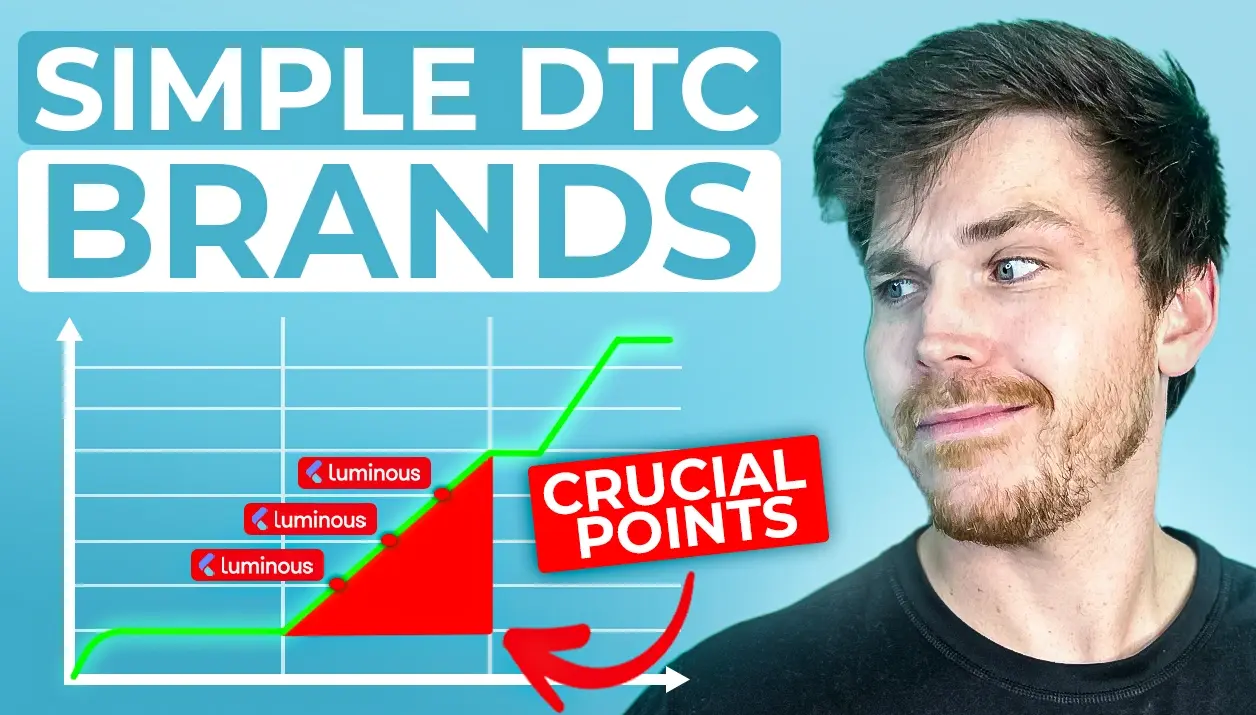
Imagine a graph with complexity on the Y-axis and milestones (revenue) on the X-axis. Ideally, a business's complexity increases gradually with growth. However, traditional DTC companies experience a complexity spike during the growth stage (around $500,000 to $5 million in sales). This is caused by a series of decisions that add layers of complexity to their operations.
The Garage Stage: Keeping it Simple
This initial stage, from the first sale up to about $500,000, is all about finding product-market fit. The entrepreneur focuses on basic tasks like making sales and fulfilling orders. Tools like Shopify, ShipStation and Google Sheets are sufficient for managing a limited product offering and fulfilling orders yourself or through a 3PL.
Growth Stage: Complexity Explosion
As the business grows, things get more intricate. Here are some common decisions that contribute to the complexity spike:
- Expanding Products: Offering two-packs, bundles, seasonal colors and new product lines increases inventory management complexity.
- 3PL Integration: Outsourcing fulfillment to a 3PL requires integrating systems for order processing and data exchange.
- Wholesale Accounts: Selling to wholesale partners introduces complexities like custom pricing, payment terms, and invoicing.
- Overseas Sourcing: Moving from a domestic supplier to overseas sourcing, or buying raw materials to cut costs, adds another layer of complexity.
None of these decisions is a big deal on its own. They compound with volume, and the longer you wait to address them, the more painful it feels.
The Pain Point: Outdated Tech Stack
The problem? The simple tech stack from the garage stage doesn't evolve with the business. Tools like ShipStation, Google Sheets and QuickBooks don't plug into a 3PL, push sales orders to a 3PL, forecast kits and bundles, or handle the wholesale flow. The gap between what the tech stack can handle and how complex the business really is, that's the pain.
The Luminous Solution
The entrepreneur, overwhelmed by manual processes and disconnected systems, feels stuck. They might be tempted to jump to an enterprise-level solution like NetSuite, which is expensive and overkill for their needs.
Luminous is designed specifically for the challenges faced by traditional DTC brands in the growth stage. Here's what we offer:
- 3PL Integration: Plug into your 3PL to pull in data and push sales orders.
- Inventory Management: A central place to manage your SKUs, kits, bundles, and forecasting.
- Wholesale Management: A wholesale portal and workflows that play well with your 3PL's WMS and QuickBooks.
- Scalable and Affordable: A cost-effective solution that grows with your business, where you only pay for what you need, without the hefty upfront costs of enterprise software.
The Profit Stage: Smoother Sailing
The good news: once traditional DTC brands get through the growth stage, it's relatively smooth sailing. Complexity generally increases gradually over time. Instead of one jack-of-all-trades ops person and fractional everything, brands start hiring full-time roles and building scalable organizations that can be acquired.
Want to compare archetypes? See Jared's breakdown of non-traditional DTC (perishable goods), or hear why implementing NetSuite would have killed his business.
Are You a Traditional DTC Brand?
If you're struggling with managing multiple channels, complex inventory, and disconnected systems, Luminous can help. We can be your partner in navigating the growth stage and unlocking sustainable success.
Book a demo and explore our solutions today and see how Luminous can empower your traditional DTC business!
Video transcript
Why Choosing Back-End Software Is So Hard
If you're an e-commerce operator looking to implement back-end software for your business, this video is for you. Look, you've got everybody from NetSuite down to SkuVault saying they're the best software for your business.
The reason it's so difficult to know if a software is going to be good for your business is this: e-commerce operations are not straightforward. For example, I could implement two supplement companies today that operate totally differently. Even though they're in the same category, their tech needs are totally different. So you can't just look to see if the software services your industry. You have to see if it actually services your operational archetype.
I promise you, if you understand your operational archetype, you will feel way less pain when you implement back-end software. So today I'm going to go over a better way to categorize yourself, so you can make better back-end tech decisions for your business.
The Traditional DTC Archetype
Okay guys, for our first archetype, we have our traditional direct-to-consumer. I call this our traditional DTC. This makes up more than 50% of e-commerce companies out there. This is the classic product focus: a founder with a unique product, or a unique twist on a product, in a specific market, going after it. It's the typical e-commerce solopreneur story.
I have a couple of brand examples to the right. We've got a Utah company — love them. True Classic, Jolie. Some pretty well-known ones, some less well-known ones.
While these companies might not be in the same category — you have a supplement company, a skincare company, an accessories company, a clothing company, across totally different verticals — what I notice is they all have almost the exact same operational evolution. And this actually dictates when and what they should implement with their software and systems. So hopefully diving into this will help you understand, if you're one of these brands, why you feel so complicated, and why the pain is so high at a specific moment in time.
The Complexity Curve
So let's dive into that. If you look to your left, on the y-axis we have the complexity curve. These are complexity markers, and all that means is these are decisions or evolutions in your operations that change the way you do business. They're making you more complicated one step at a time.
The x-axis is the milestones, so this is more like time and revenue. Ideally, your business gets perfectly more complex as time goes by. It should just be a straight line: you're evolving with revenue, you're growing, and you're getting equally as complex.
The problem is, with e-commerce companies, it doesn't work like that. You'll have times where your complexity peaks way up, and it's because of specific decisions. So let's dive into that.
The Garage Stage
Each one of these companies has what I call a garage stage, and this doesn't even have to take place in a garage, per se.
So let's do an entrepreneur example. This is Billy. He started a clothing company. Let's say he has a new take on joggers: the most flexible and simplest material, that's just amazing, and it looks stylish. So Billy starts his e-commerce company. He buys a bunch of stuff from a supplier, and at this stage, he's jazzed. He's just trying to get product-market fit. He's trying to get people to buy his product and seeing if people like the same stuff he likes. And he's succeeding. He's going from his first sale all the way to about $500,000 in sales. That's the garage timeline I usually see. It's really just a founder who made some cool shit and is trying to find product-market fit.
So let's talk about his operational complexity. It starts out really flat. It's pretty straightforward. These types of e-commerce companies are relatively easy to start in an operational sense, because Shopify and Amazon have made it so easy to start a business selling one or two products.
Your complexity markers are really just: I get my first sale on Shopify. I get my first sale on Amazon. Either a 3PL is fulfilling for me, or I'm doing all of the operations myself out of a garage, just like Billy here in this picture. I'm slapping a label on as the order comes in and shipping it out. Probably not making much money at all, but I'm figuring out, wow, people actually like my product. That's pretty cool.
Now, at this stage, the tech stack that will service you is pretty straightforward. I see this a million times: ShipStation and Google Sheets. You don't need something too complex. You're just fulfilling orders on Shopify, maybe using ShipStation to print labels, and maybe some Google Sheets to keep track of basic inventory numbers or your purchase orders. That's serving you up to this point, and it's pretty good.
The Growth Stage
Then there's the growth stage, which is typically from $500K to $5 million. This is where things get a little bit more painful.
This growth stage is such an interesting one. With this archetype, these types of brands make the same decisions. It's almost cookie-cutter, like a cardboard cutout. You can predict it. Almost every single one of them makes these same decisions.
In the growth stage, you've found some product-market fit. Well, guess what? Boom, your complexity starts to shoot way up. And here's why: at any point, it doesn't necessarily feel like you're making bad or complex decisions, but over time it compounds. And the longer you wait to address the complexity brought on by these decisions, the more painful it will feel.
Billy's Complexity Markers
So let's dive into some of these complexity markers. Billy is now spending most of his day wondering, “Man, I used to just put a label on the box, ship it out and run things on Google Sheets. It was so good. Now I'm in spreadsheets all day, and I'm wondering what the hell I'm doing.”
So what got Billy there? Well, Billy outsourced to a 3PL at the very beginning. He got his first couple of sales and thought, “Yeah, let's just send this to a 3PL. I want to focus on sales.” Awesome.
He immediately starts expanding products. He starts selling a two-pack, a three-pack and bundles, and he starts doing seasonal colors and different cuts. He's even thinking about doing a women's clothing line.
He also gets his first specialty wholesale account. He knows a buddy who knows a buyer at a local place, and they're like, “Hey, can we buy a hundred units every week?” “Sure, let's do it.”
On top of that, he's like, “You know what? I don't want to buy from this domestic supplier. I can cut the costs in half if I just source this from overseas. Let's do this.” Or maybe he even starts sourcing raw materials to cut costs.
All of these decisions, in a vacuum, are not really that big of a deal. With your first wholesale accounts, you're just sending emails back and forth. You tell the guy you hired, or you just email the 3PL, “Hey, send out these hundred units to this person.” It's not that big of a deal. But these things compound in the growth stage with more volume.
Pretty soon, Billy — who has typically only hired one person to help him out, the jack-of-all-trades ops guy or girl — is sitting there wondering, why do we feel so complex?
Why the Tech Stack Falls Behind
The reason why, and what I see so often with the traditional DTC archetype, is that their tech stack does not evolve from garage to growth. What does that mean? It means he's still servicing all this complexity with the same tech stack: ShipStation, Google Sheets, QuickBooks. You could also replace ShipStation with other point solutions, like Pirate Ship or other shipping software.
The problem is, these tools don't help you plug into a 3PL. They don't help you push sales orders to a 3PL. They don't account for kitting and bundling, and particularly the forecasting of kitting and bundling, and the consumption data that flows into a forecast. They certainly don't account for a wholesale account and the flow that happens there, like custom pricing and payment terms, pushing that invoice to QuickBooks and also pushing it to your 3PL. I've got to tell you, this tech does not service any of that.
This red line right here is what the tech stack services, and this right here is the delta. This is pain right here. In short, this is why I see so many of these traditional e-commerce archetypes hit this point at the end of their growth stage or the beginning of their profit stage.
You Don't Have to Go to NetSuite
This is Billy. He's like, “I have so much pain. My tech sucks so much. My processes aren't the best. I guess I need to solve all of my problems and go to NetSuite.” No, you don't. You don't have to go to NetSuite.
In fact, you just need a system that is optimized for traditional DTC: a company in the growth stage with low margins that's hardly making money. That's not NetSuite. And this is actually where Luminous comes in.
Where Luminous Comes In
Luminous is the back-end solution that comes in during your growth stage. We're purpose-built for the modern e-commerce company, and we scale with you at any one of these complexity points.
It's like, “Jared, actually, we just need to be able to plug into our 3PL, consume all the data, and push our wholesale sales orders.” It's okay, we've got you. And it's going to be cost-effective, too, without a million-dollar implementation.
“We expanded our products to kits and bundles, and we're expanding a lot of SKUs. I think we need a central repository that we can actually forecast from, and have one single source of truth.” Yes. And you don't have to pay thousands and thousands of dollars a month for that.
“We got our first wholesale account. Jared, we just need something that will play well with our 3PL's WMS and with QuickBooks.” Yeah, we have a wholesale portal. We purpose-built our system to handle the things traditional e-commerce companies run into at every stage, and you're only paying for what you actually need.
So that's where Luminous comes in, at this painful stage for you guys. You don't have to be Billy here, who's like, “I guess I've got to bite the bullet, go to NetSuite, and spend $200,000 on implementation and $10,000 a month.” No, you don't have to.
The Profit Stage
Now, some good news for the traditional e-commerce archetype: anybody who gets out of this stage, it's pretty smooth sailing from there. Complexity just generally increases over time.
And this is where Billy, instead of having one jack-of-all-trades ops person and outsourcing everything — fractional CFO, fractional bookkeeper, fractional everything, outsourcing to a 3PL — in the profit stage, you start to see brands taking on roles full-time and building actual organizations that are scalable and can be acquired. So it's a great path for so many businesses.
This right here is the pain that Luminous comes in and solves, though. So hopefully that helps, guys.