

Persona: Omnichannel Brands


- Not Your Average DTC Model
- The Growth Curve: Complexity Strikes Early
- The Exploration Stage: Setting Up Shop (Literally)
- The Channel Optimization Phase: Chaos Reigns Supreme
- Spreadsheets and Dreams Don't Scale
- Luminous: The Perfect Fit for Multi-Channel Mayhem
- Beyond the Madness: Dominating the Multi-Channel Landscape
- Are You a Multi-Channel Madman?
The world of e-commerce can be a complex one, and choosing the right software is crucial for success. Here at Luminous, we understand the unique challenges faced by different e-commerce archetypes. Let's talk about the Multi-Channel Madness archetype, one founder and CEO Jared Ward knows firsthand from his time as CEO of an e-commerce company that fit it perfectly.
Not Your Average DTC Model
Unlike the product-focused Direct-to-Consumer (DTC) model, Multi-Channel Madness thrives on finding and selling commoditized products across as many channels as possible. They're the spray and pray masters of e-commerce, excelling at out-marketing and out-operating the competition. Think Shopify, Amazon, Etsy, Groupon, Zulily, wholesale and deal platforms – they're everywhere.
The Growth Curve: Complexity Strikes Early
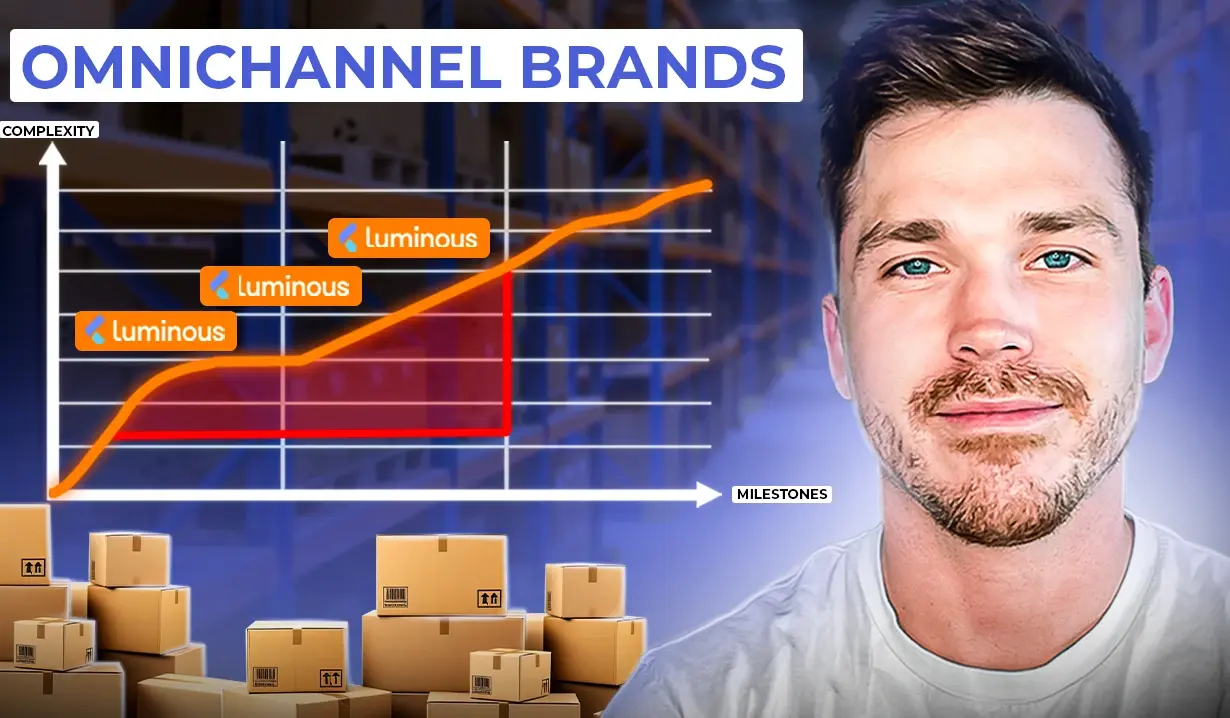
Imagine a graph with complexity on the Y-axis and milestones (revenue) on the X-axis. Ideally, a business's complexity increases gradually with growth. But for Multi-Channel Madness, it's a different story. Their complexity spikes early on, leading to growing pains as they struggle to manage their sprawl.
The Exploration Stage: Setting Up Shop (Literally)
This stage runs from zero to about $2 million in revenue, and it starts with the first online sale. At Qualtree, the company Jared later led, the founder started by personalizing cutting boards in his garage and selling them on Etsy. Fueled by early success, the Multi-Channel Madman expands rapidly, adding more SKUs and testing new channels like Groupon and a Shopify store. ShipStation and Google Sheets manage things initially, but cracks soon begin to show.
The Channel Optimization Phase: Chaos Reigns Supreme
By the time they reach about $3 million in revenue, the limitations of their garage tech stack (ShipStation, Google Sheets, and maybe QuickBooks) become painfully clear. These tools simply can't handle kitting and bundling, forecasting and purchasing, or production as you expand to hundreds of products across seven channels. Expanding into wholesale usually shines the brightest light on what's breaking.
Spreadsheets and Dreams Don't Scale
- Fragmented Data: Inventory and sales data are scattered across multiple channels and platforms, with no single source of truth, making forecasting and planning for key marketing and sales events a nightmare.
- Manual Processes: ShipStation has a concept of products, but it doesn't handle kitting and bundling from an operational perspective, or any production management.
- Limited Functionality: ShipStation and Google Sheets mainly pull in sales data and connect order flow to your channels. That's about it.
Luminous: The Perfect Fit for Multi-Channel Mayhem
Luminous typically comes in at the channel optimization stage, when you're selling across three to five channels, have more than 100 products, and have built out an ops team. Here's how we can help:
- Centralized Hub: Luminous acts as a central repository for your products, channels and wholesale flow, replacing the patchwork of spreadsheets.
- Built for Multichannel Operations: Handle kitting, bundling, purchasing and production alongside your channel sales.
- Better Forecasting: With all your data in one place, you can actually forecast and plan for your key marketing and sales events. See how MRP forecasting works.
- A Middle Ground on Price: Point solutions like SkuVault are cheaper but can't solve every use case, and NetSuite can, but at a cost most growing brands can't afford. Luminous sits in between.
In fact, Luminous was born out of this archetype: Jared used it at Qualtree because it could fill these needs at a cost in between the point solutions and the NetSuites of the world. Hear more in why implementing NetSuite would have killed his business.
Beyond the Madness: Dominating the Multi-Channel Landscape
Once the operational hurdles are overcome, Multi-Channel Madness companies can truly flourish. They can strategically acquire and grow the business, scale their operations, and dominate their niche like the quintessential example, PMall (Personalization Mall).
Want to compare archetypes? See Jared's breakdowns of traditional DTC brands and non-traditional DTC (perishable goods).
Are You a Multi-Channel Madman?
If you're wrestling with the growing pains of managing multiple channels, Luminous can help. We can be your secret weapon to conquer complexity and unlock explosive growth. Book a demo to explore our solutions today and see how Luminous can tame the Multi-Channel Madness within your business!
Video transcript
Why Choosing Back-End Software Is So Hard
Look, if you're an e-commerce operator looking to implement back-end software for your business, this video is for you. You've got everybody from NetSuite down to SkuVault saying they're the best software for your business.
The reason it's so difficult to know if a software is going to be good for your business is this: e-commerce operations are not straightforward. For example, I could implement two supplement companies today that operate totally differently. Even though they're in the same category, their tech needs are totally different. So you can't just look to see if the software services your industry. You have to see if it actually services your operational archetype.
I promise you, if you understand your operational archetype, you will feel way less pain when you implement back-end software. So today I'm going to go over a better way to categorize yourself, so you can make better back-end tech decisions for your business.
The Multi-Channel Madness Archetype
All right, guys, for our next archetype, we have multi-channel madness. This archetype is near and dear to my heart. I was actually CEO of an e-commerce company that fit this archetype perfectly.
So, general bullet points of who this archetype is. These are multi-channel salesmen. Unlike the traditional DTC archetype, they're not really a product-focused organization, meaning they're not bringing unique products. Typically these are more commoditized products, nothing too unique, but they're excellent marketers and operators.
This is the sort of spray-and-pray business model, where you're taking commoditized products and trying to outsell and outoperate everybody in the market. It's a very difficult business to be in. It was one that I was CEO of, and I have a lot of empathy for these guys as well. So let's dive into it.
The Complexity Curve
Again, the point of this is we have our complexity over here. These are the decisions or things that happen in your business that make you more complex over time. And on the x-axis, this is milestones, so think revenue and time increasing.
Ideally, you'll have a perfect straight line, where you're getting equally complex as your revenue is growing. The problem is, a lot of times for these e-commerce archetypes, it doesn't work like that, and it causes incredible pain. Whenever you get super complex in a short period of time, that's where the pain happens. And a lot of times, you misimplement or misdiagnose your problems.
Diagnosing Multi-Channel Madness
So let's diagnose some of the problems of the multi-channel madness archetype. I was at a company called Qualtree. One of their competitors was PMall, Personalization Mall. That's a great example of this archetype.
Again: commoditized products, nothing really that unique. These companies typically have hundreds, if not thousands, of SKUs, and they sell them across every channel imaginable. Think Shopify, Amazon, Zulily, wholesale, Groupon, deal platforms, Etsy — anywhere you can put that product and sell it for a profit, they're going to do that. And they're excellent marketers and salespeople.
Stage One: Exploration
So let's dive into this. The first stage is exploration. I'd say this stage is anywhere from zero to about $2 million in revenue. This is them just trying to see what they can sell. And here's what gets this archetype complex early, and what they should be solving for when they're considering new processes and tech.
With this archetype, it gets pretty complex pretty fast, and it's because you get your first online sale. For example, at Qualtree, the company I was CEO of, the founder started in a garage, personalizing cutting boards. At the very beginning, he was just selling cutting boards on Etsy.
So you get your first online sale, and it's like, “Oh, well, this is kind of working. Whoa.” So you buy a bunch more SKUs and expand a channel. Early on in their history, in this exploration stage, they're just trying to see what will hit where. Cutting boards kind of fit on Etsy. Awesome. Groupon? Boom, we're going to expand to Groupon. Let's set up our own Shopify website. We're going to set up this and this.
So early on, you're just exploring, trying to see if things will fit. It doesn't feel too complex at the beginning, and you're really just solving everything you need to solve with ShipStation and Google Sheets. You don't need much more.
Stage Two: Channel Optimization
But once you get done with this exploration phase, that's when things start to feel pretty complex. I typically see it when brands cross about $3 million in revenue. Then you get into the channel optimization phase.
Here's the problem. This is where these types of companies feel pain with ShipStation and Google Sheets — and we can throw in QuickBooks as well. The back-end software they've implemented, this red line I'm drawing, only handles up to this complexity. It's not going to account for your bundling and your kitting, and forecasting and purchasing as you're expanding. Pretty soon you're selling 300 products across seven different channels that all go through a complex workflow.
ShipStation and Google Sheets really only handle and automate your operations up to these complexity markers. They pull in your sales data and connect your order flow to the different channels. That's about it. ShipStation has a concept of products, but it doesn't deal with kitting and bundling from an operational perspective, nor does it deal with any flow of production management.
In my experience, multi-channel madness brands start feeling a lot of pain at the end of their exploration phase. And the more they ignore it, the bigger the delta — or the pain — between what their software is currently handling and what they need their software and processes to handle.
Where Luminous Comes In
So for these brands, Luminous typically comes in at the channel optimization stage. You've already gotten some product-market fit in some of your channels. You're probably selling across three to five channels. You have over a hundred products. You've hired out a general team. You might have a full-time marketer at that point. You definitely have a lot of people in ops — somebody running ops and a lot of warehouse workers. This is typically where we come in.
So Luminous is a unique fit for multi-channel madness companies when they're at the end of their exploration phase. Google Sheets and ShipStation can get you to $1 million or $2 million in revenue, but that tech stack is not going to solve for the pain you're feeling when you get to your channel optimization stage.
It can feel a little bit like this when you start expanding to wholesale channels. That's normally when a big light gets shined on things, and it breaks. Now I don't have a central repository that accounts for and handles my wholesale business flow, the 300 different products and the seven different channels they're selling across. At a certain point, at the end of the channel optimization phase, it becomes impossible to forecast and plan for your business's key marketing and sales events.
So that's where Luminous comes in. We can come in as a central repository that does not break the bank.
My Two Choices at Qualtree
When I was CEO of Qualtree during this channel optimization phase, it felt like I had two choices. We couldn't forecast. We didn't have a system that was handling our wholesale, the thousand different products across seven different channels. There was no single source of truth capturing all of this data and feeding it to me in a meaningful way.
So it felt like we had two options that could actually service our complexity. It was either a point solution, like SkuVault, that cost $500 or $1,000 a month but couldn't solve for all of our use cases and couldn't really do what I needed it to do. Or it was NetSuite, which could come in and solve all of our problems, but it was going to cost $200,000 and something like $7,000 a month. We definitely didn't have the margins or the ability to implement that.
So Luminous is that nice middle ground. Luminous was a solution we used at Qualtree because it could fill all of these needs for this archetype, and it could do it at a cost that was in between. It wasn't as cheap as the point solutions, but it wasn't nearly as expensive as the NetSuites of the world, and it did solve all of my problems. That's actually where Luminous was born: out of multi-channel madness and what these operators run into.
Beyond the Madness
The cool thing about multi-channel madness, especially if you look at the quintessential example, PMall, is that they've gone way past the expansion. Once you get past it and solve all of these things — you solve the operational crises, you're able to forecast across all of your channels, and you nail down all of your operations — eventually you get to a point where you're strategically acquiring and growing the business meaningfully over time.
And as you can see, our multi-channel madman here has taken over the world of his industry, and he's doing great. So yeah, that is our multi-channel madness archetype right here.